
Reimagining Fact Timelines
in Everlaw
Solving the narrative gap in litigation, enabling legal teams to move
beyond raw data and proactively evaluate case claims and risk
Role: Design lead (sole designer)
Type: 0→1 strategic initiative
Released: December 2025
Collaborators: PM, engineering
Impact at a glance
Validated with 20+ attorneys at Everlaw Summit; feedback confirmed strong demand for narrative-focused workflows
Established a new mental model (“Facts”) that now serves as a foundation for broader Storybuilder and AI-powered experiences
Shifted product direction from incremental improvements → long-term narrative strategy
OVERVIEW
Defining the narrative layer for litigation
In complex litigation, attorneys struggle to transform evidence into a clear narrative. Existing timeline tools focus on data entry, not storytelling.
I led design for a new approach to timelining on Everlaw by introducing Facts as first-class objects, enabling attorneys to build, contextualize, and reason about case narratives. This work required advocating for a larger architectural shift rather than a faster incremental solution — trading short-term efficiency for long-term strategic impact.
PROBLEM
Attorneys don’t just need timelines — they need stories.
The initial user request was simple: A more visual timeline to capture key events on Everlaw. While Everlaw already had a timeline tool, it was optimized for:
An evidence-first, linear date approach
Isolated events
Minimal contextual relationships
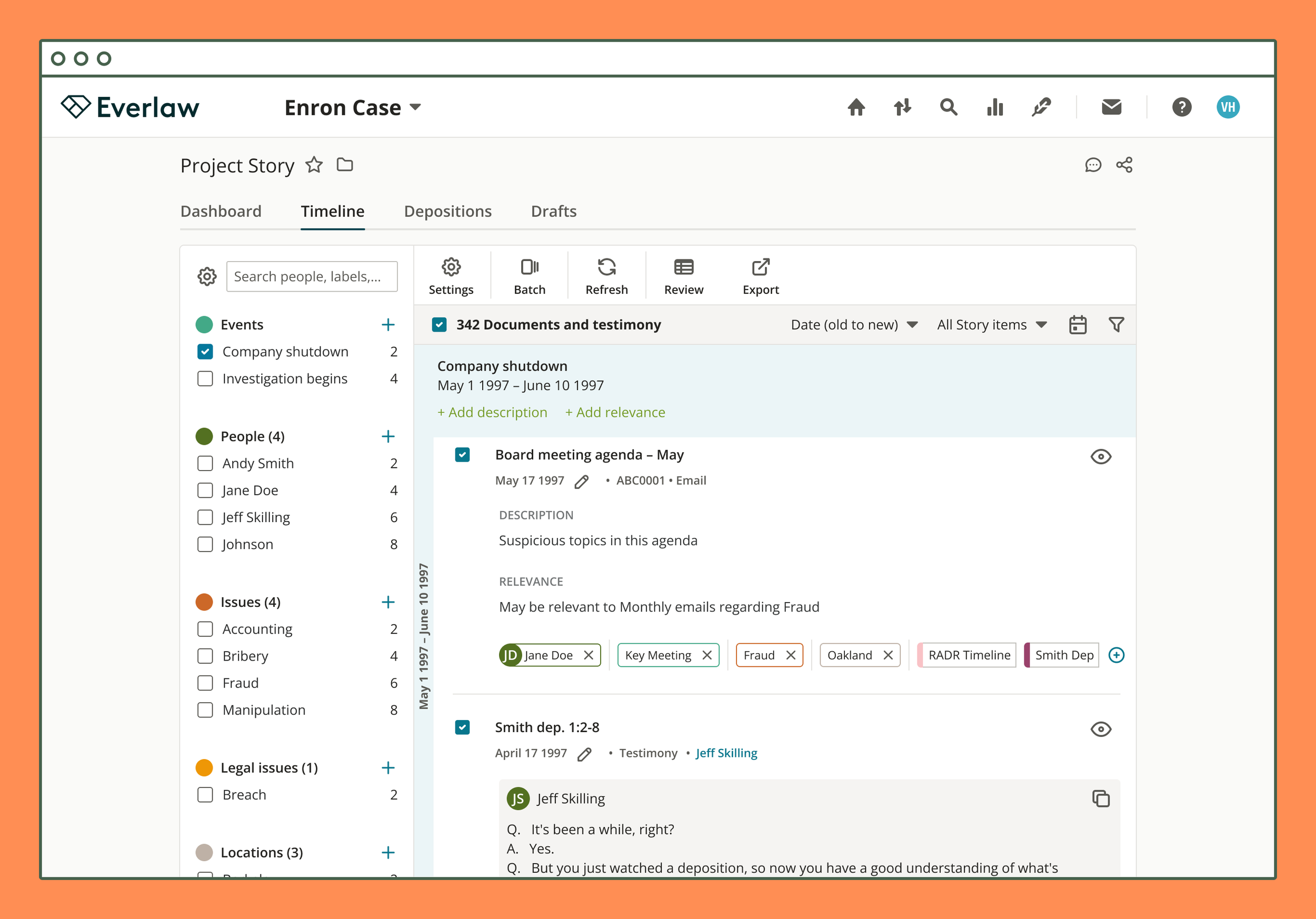
Existing Timeline chronology with events
The tool primarily reflected a series of document titles (e.g., "ABC0001," "Enron email thread") and dates, not narrative structure. Visualizing raw evidence this way would not solve the user's core need—it would only create confusion.
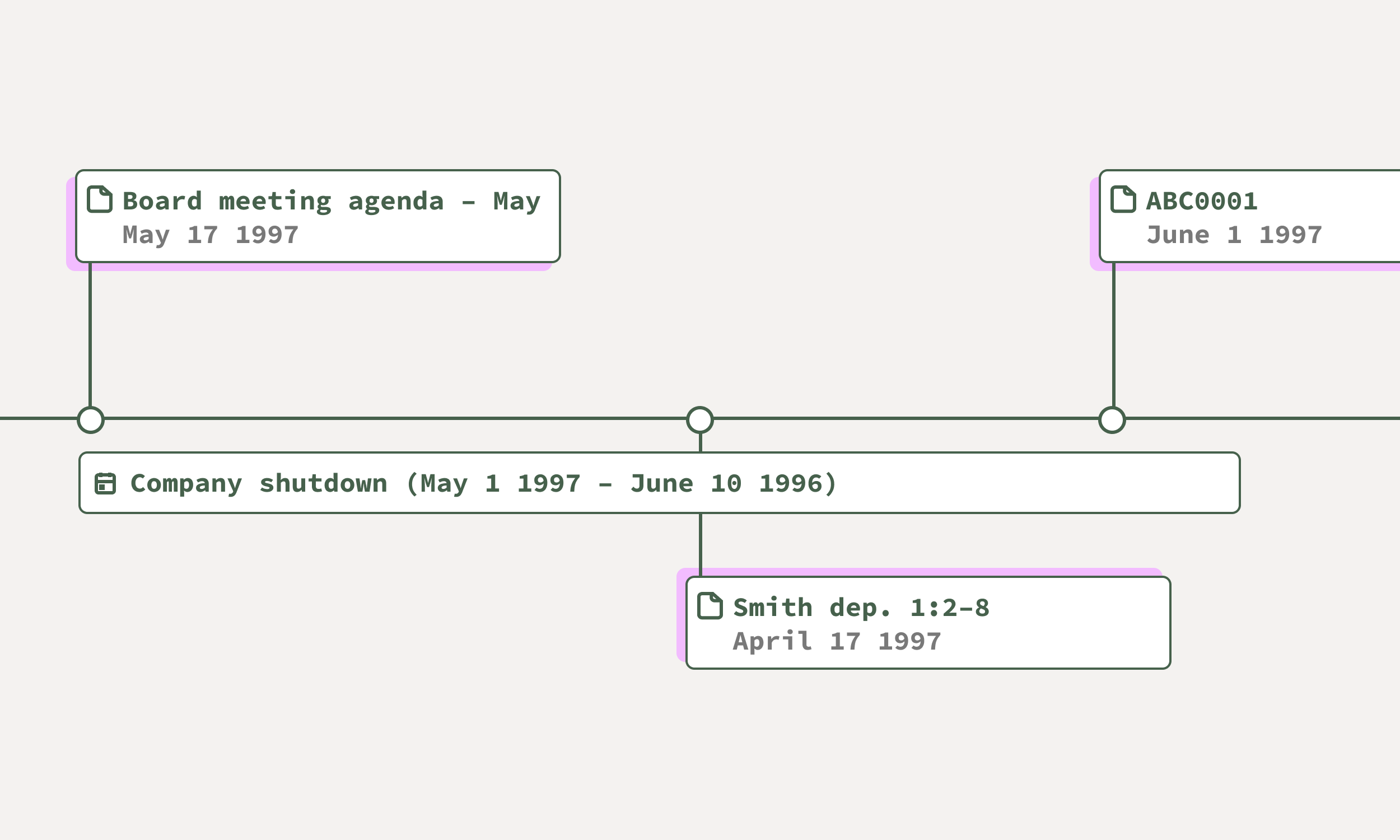
Through research and conversations, we learned:
Attorneys often start with conceptual facts or claims, even when no evidence has been introduced yet
Narrative building is iterative and non-linear
Existing tools forced users to “fit their thinking” into rigid structures
This resulted in:
Heavy manual work outside Everlaw
Fragmented storytelling across documents, notes, and spreadsheets
Difficulty evolving a narrative as cases progressed
It became obvious that timelines aren’t the product — narrative reasoning is.
Attorneys needed a system that:
Let them reason about events and facts before tying it to evidence
Provided holistic context and see clear relationships within the timeline
Scaled from early case exploration to trial preparation
This reframed the problem from “How do we improve timelines?” to:
“How do we support narrative construction across the litigation lifecycle?”
THE STRATEGIC DECISION
Securing buy-in for a zero-to-one solution
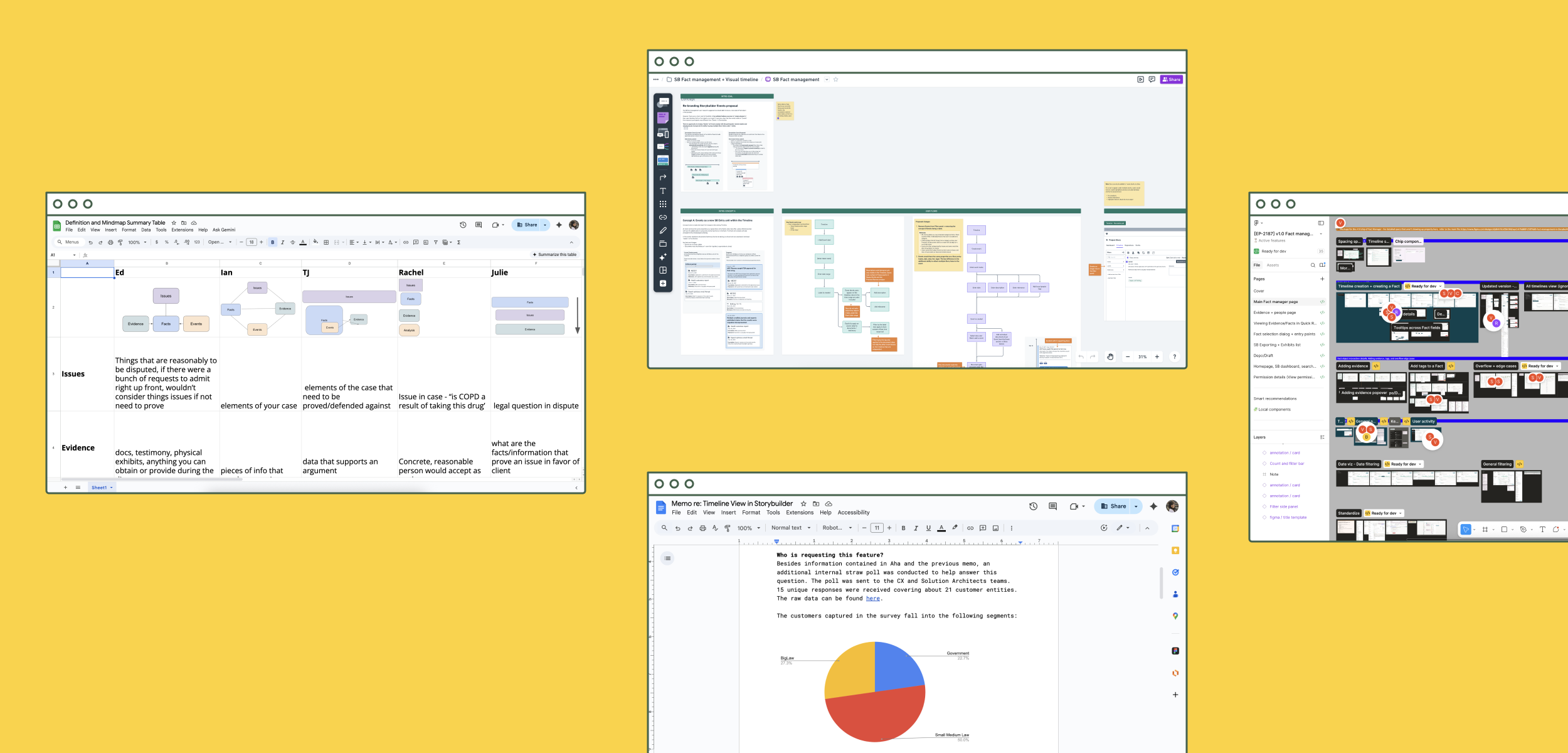
Our research led us to redirect the stakeholder discussion to introducing data extraction ('facts')—a more critical need than the originally requested timeline view. We ideated three possible directions:
Option 1: Refactor and convert the existing "Events" tool to align better with users' needs
✅ Moderate lift
👎 Preserved the same rigid mental model
👎 Would not solve the narrative gap
Rejected — incremental improvement, limited strategic upside.
Option 2: Introduce “Facts” into the existing timeline
✅ Fastest to ship
✅ Some improvement to flexibility
👎 Mixes two competing mental models in one space
Rejected — quicker, but overall experience of the timeline could be compromised and unintuitive.
Option 3: Introduce a new workspace built around “Facts”
✅ Better matches user’s mental models
✅ Enable non-linear thinking
✅ Create a scalable foundation for future features (including the originally requested timeline view and AI integrations)
👎 Higher upfront cost
Chosen — despite the risk, this option aligned best with user needs and long-term product strategy.
We advocated strongly for Option 3 and secured buy-in, moving the project from incremental iteration to a strategic platform extension.
SOLUTION
From dispersed data to unified contextual timelines
Fact-first synthesis
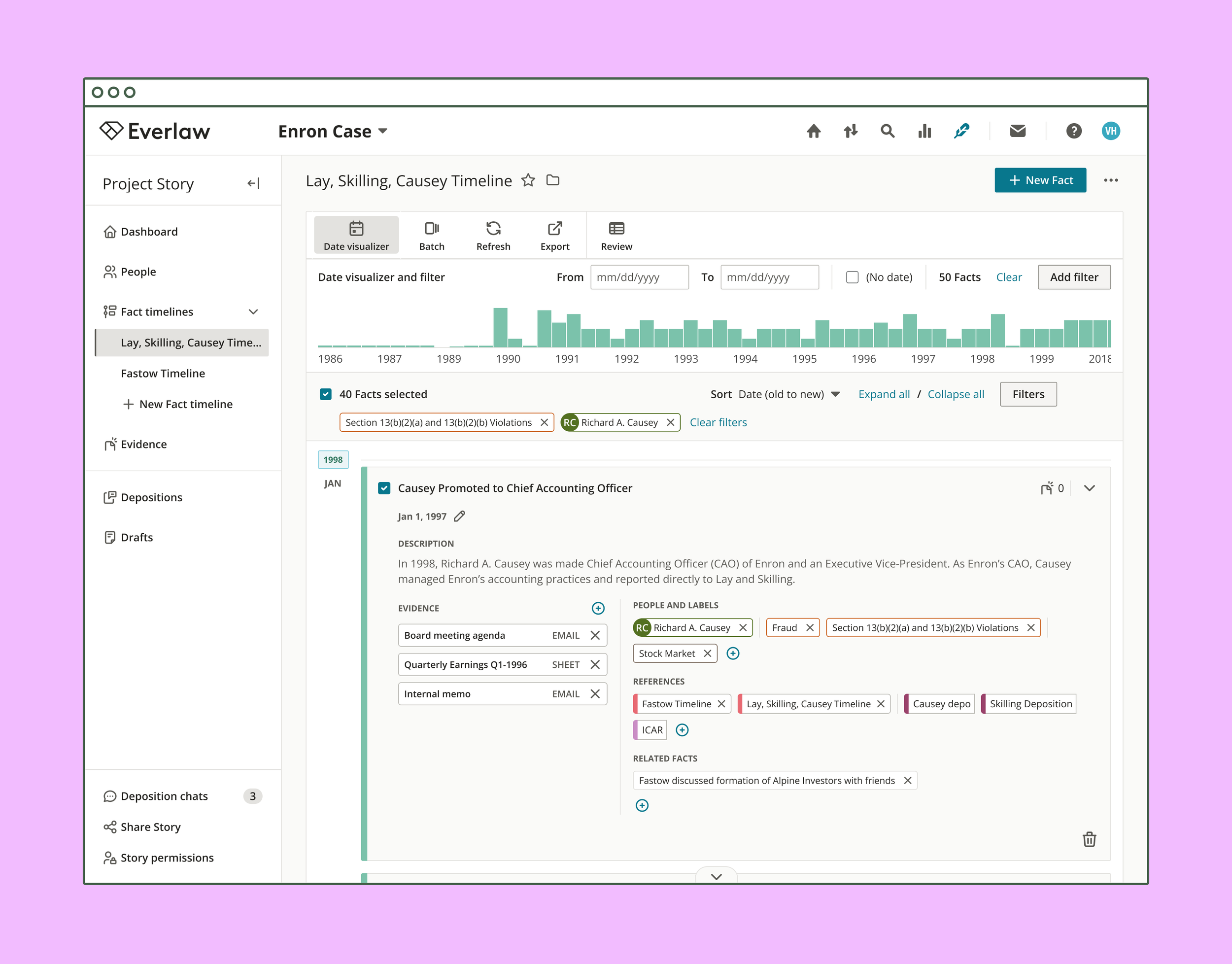
We introduced the "Fact" object, atomic units representing claims, events, or assertions — not just document timestamps. Decoupled from evidence, Facts allow attorneys to start with known claims, iterate as evidence comes in, and gradually refine a compelling case narrative.
Contextual timelines for complex cases
The ability to create multiple timelines enables users to organize facts by legal issue or entity, instantly visualize gaps, and conduct risk assessment even in the most multi-faceted cases.
Seamless platform integration
Users can tag, cite, and reference strategic facts from any document or draft, accelerating case preparation workflows with zero friction and complete data consistency.
VALIDATION & IMPACT
Early signals, lasting Impact

Our users providing feedback during the Everlaw Summit focus group
Because this was a foundational initiative, success was measured through directional validation, not just usage metrics.
What we validated
Strong resonance during focus groups with 20+ users
Clear recognition of the narrative problem
Enthusiasm for fact-first thinking over rigid timelines
This is a “huge fix for most users”
The experience is “faster, smoother” and “a lot more user-friendly”
It would significantly “reduce redundant work and streamline handoffs”
What we planned to measure next
Adoption of Fact timelines
Frequency of fact creation and reuse across workflows
Downstream impact on Storybuilder engagement and suite adoption
TAKEAWAYS
The value of saying no 🙅
This project reinforced that impact often comes from saying no to the easier solution. By slowing down to make the right architectural call, and pushing back on early proposals and stakeholder skepticism, we unlocked significantly more value—for users and for the product’s future.